1.Crystal spectrometer
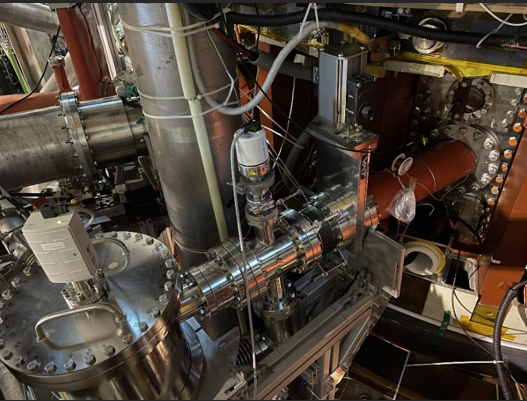
A crystal spectrometer has been designed and developed to measure X-ray line at 0.39494 nm from He-like Ar ions, Ar16+ covering the wavelength region of 0.394–0.4 nm. The spectrometer is having a Si (111) cylindrical crystal and X-ray CCD detector and coupled to Aditya-U tokamak tangentially at an angle of 260 with respect to the toroidal direction in the magnetic axis for measuring core toroidal rotation velocity. The plasma to crystal and crystal to detector distances have been kept at 1.47 m and 0.5 m, respectively, to detect a sufficient signal considering Aditya-U tokamak plasma parameters and its geometrical constraints,
2.Space resolved visible spectroscopy system
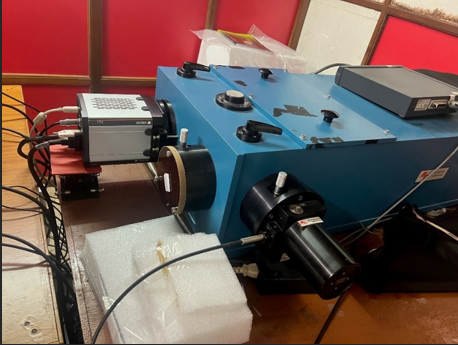
Space resolved visible spectroscopy system on Aditya-U tokamak measure the radial profile of spectral line emissions in visible range. It has 1880 groves/mm grating and a sCMOS camera as the detector providing spectral resolution of 0.032 nm when operated with 75 um entrance slit. Thus diagnostics can view the plasma using multiple lines of sight using collection optics placed either on a tangential or a top triangular ports. The radial profile of ion temperature, toroidal rotation are measured routinely by recording passive CX line of C5+ ions from Aditya-U plasma. Neutral particle dynamics, intrinsic toroidal rotation and impurity transport are investigated from the measurement.
3.Photomultiplier-tube (PMT) based diagnostic systems
1. Photomultiplier-tube (PMT) detector based diagnostic systems
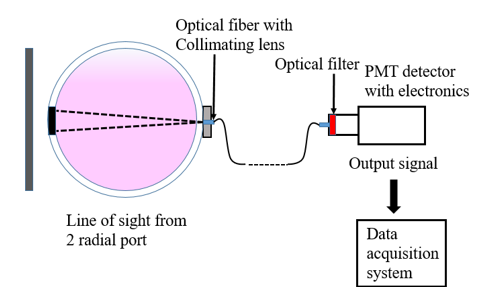
Monitoring emission lines from fuel and impurities is most important in a tokamak plasma, as presence of impurities causes fuel dilution and radiative cooling, which deteriorates plasma performance. Impurities enter into plasma mainly through interaction of plasma particles with vacuum vessel and with plasma facing components in a tokamak. PMT detector based diagnostics have been installed on ADITYA-U, SST-1, and SS-ST tokamaks to monitor time evolution of emission lines from Hydrogen (Hα, Hβ) and from impurities like O+1, C+1, and C+2 during plasma discharges.
Optical fibers are used to collect emission from plasma and transport it to detector. Optical interference filters pass only a selected wavelength, which is subsequently detected by PMT detector and rest of the light is rejected.
4.NIR spectroscopy
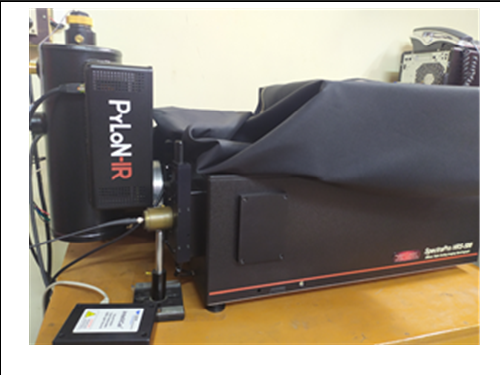
• UV-visible spectroscopic diagnostics face many challenges in reactor like environment due to degradation of optical properties of components in the system. But optical materials properties are not much affected the NIR range. Therefore, NIR spectroscopic diagnostics can be effective tools for investigation of fusion grade plasmas. The main purpose of installation of NIR diagnostic system on ADITYA-U is to characterize and investigate emission in the near-infrared spectral regions coming from edge and scrape-off layer regions of the tokamak. NIR system on ADITYA-U consists of a 0.5 m spectrometer having three gratings, 300 g/mm, 600 g/mm, and 1200 g/mm with InGaAs photodiode array detector.
5.Visible survey spectroscopy
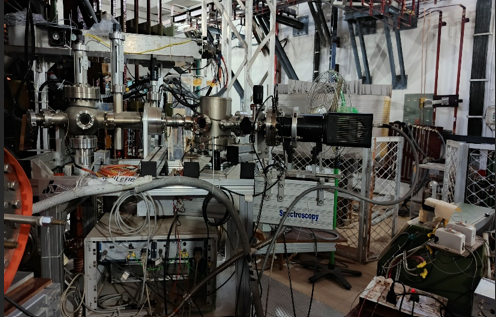
Visible survey spectrcopy on tokamaks in IPR comprises of a three channel miniature spectrometer having lower spectral resolution and 5-channel miniature Spectrometer with better wavelength resolution covering the wavelength range of 300–800 nm and two 0.5 m spectrometer. These setup used collimating beam probes and optical to collect and transmit for recording the visible spectrum. Responsibilities included acquiring full visible survey spectral lines from neutral hydrogen, and neutral and low ionized H, He, Li, C, and O. Temporal evolution of plasma emissions are analyzed for understanding edge impurity behavior. Particle and impurity influxes is investigated to understand their roles in the plasma properties and radiation loss.
6.Space resolved visible continuum measurement Diagnostic
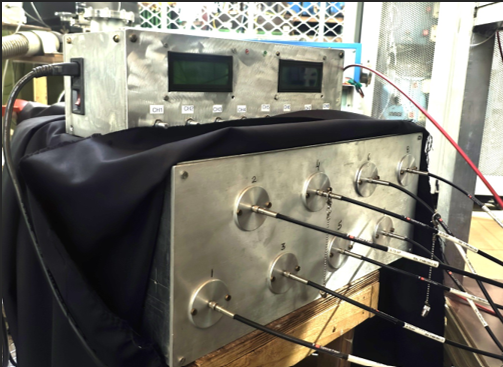
Tokamak plasma emits continuum radiation primarily due to bremsstrahlung processes in the visible wavelength range. A space-resolved continuum measurement diagnostic system installed on the ADITYA-U tokamak is used to measure the visible continuum radiation emitted by the plasma. The diagnostic system collects light from eight lines of sight extending from the plasma center to the outboard side of the tokamak through a rectangular viewport. Collimating beam probes with a spatial resolution of 2.5 cm are used for light collection. The collected light is transmitted through optical fibers to a 536 nm interference filter with a bandwidth of 3 nm for wavelength selection and filtered radiation is t detected using eight photomultiplier tubes. The acquired signals are digitized using the ADITYA-U DAQ with a temporal resolution of 10 µs. The diagnostic is primarily used for estimating the plasma effective charge (Zeff).
7.VUV survey spectroscopy system
VUV spectroscopy plays an important role in tokamak to understand impurity dynamics inside the plasma.
1. VUV survey spectroscopy system: This system has the selectable toroidal gratings with 290, 450, and 2105 g/mm and a combination of multi-channel plate and visible CCD as the detector. The system monitors the VUV spectral emissions within 10 to 180 nm wavelength from highly ionized medium and high- Z impurities like Ne, Ar, Cr, Ni and Fe along with low-Z impurities, such as Li, C, O, and B. In Aditya tokamak, Ar and Fe transport has been investigated using this system and VUV impurities was monitored when it was coupled to SST-1 tokamak.
2. VUV impurity monitoring system: This system has 1200 grooves/mm grating and X-ray CCD as the detector and operated in 30 to 300 nm wavelength range. It is also equipped with electron multiplier tube (EMT) to monitor temporal evolution of pre-selected VUV line. In ADITYA-U tokamak, C4+ VUV lines at 227.1 nm are monitored using this spectrometer.
8.PMT array based Diagnostic system
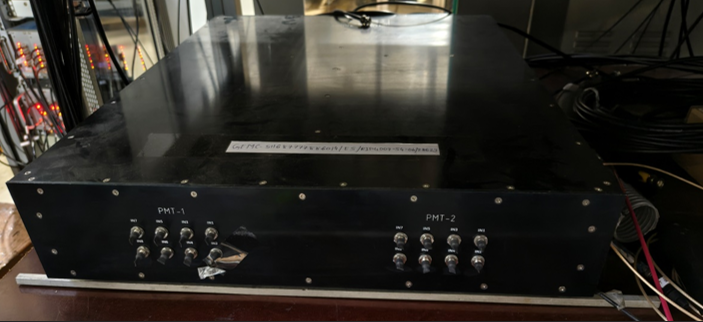
To carry out experiments on transient event in a Tokamak two PMT array based diagnostics has been developed. These diagnostic systems consist of a 16-channel PMT module and an 8+8 channel PMT module, allowing simultaneous observation of plasma radiation from multiple radial locations. One of these two diagnostics is being planned to carry out the divertor spectroscopy. In Aditya-U tokamak, light is collected using collimating beam probe with chord diameter of 1.8 to 2.5 cm at horizontal plasma mid-plane. Poloidal asymmetry in ion and neutral temperatures, impurity transport, neutral particle penetration, effect of gas puff on fuelling efficiency are investigated using these tow diagnostics.
9.Bolometer Diagnostics
Radiation loss measurement is vital for maintaining the delicate power balance and preventing sudden thermal collapses in tokamak. In IPR, many AXUV detector based Bolometer diagnostics viewing whole nearly plasma diameter have been developed to measure total radiation power loss for all three tokamaks. Three arrays of AXUV diodes are also implemented on the tokamaks to measure the radial profile of emissivity of radiated power.
10.Fast visible imaging diagnostics on Tokamak
• Fast Visible Imaging Diagnostics for the Aditya-U and SST-1 tokamak is operational to study high-speed plasma phenomena with enhanced temporal and spatial resolution. It is having a CMOS sensor based (Phantom v7.1) high speed camera, can capture 150 k frames per second (fps) at a resolution of 16 × 8 pixels is used for plasma imaging.
• These studies contribute significantly to understanding plasma behavior, pellet injection dynamics, and transient events in fusion devices. The tearing mode
and saw-teeth instabilities have also been studied using this diagnostic. The developed imaging diagnostic is expected to support advanced plasma research and strengthen ongoing efforts toward fusion energy development and diagnostic innovation.
11.Magnetic diagnostics
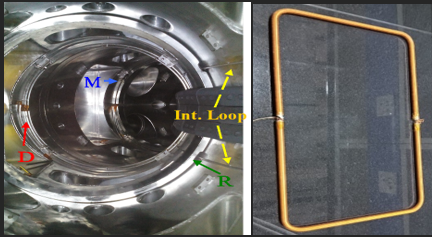
Magnetic diagnostics (magnetic probes, Rogowski coils, flux loops, and diamagnetic loops and Mirnov coils) are developed and installed on tokamak to measure plasma current, loop voltage, plasma position, MHD mode and stored energy. These plasma parameters are essential for plasma operation. Rogowski coil, which enclosed the plasma column, measures plasma current. Flux loop, a single turn loop placed along the toroidal boundary of plasma, measures voltage that causes break down and drives plasma current. Different magnetic diagnostics such as discrete magnetic probes and flux loops measure plasma position. MHD mode number is measured by Mirnov coils. Stored energy is measured by a diamagnetic loops system. Outputs of magnetic diagnostics in voltage units are processed to obtain those plasma parameters in their respective units. Measurements of plasma current and plasma position are performed in real time whereas MHD mode and stored energy are obtained from post-discharge analysis.