Open House Help Desk Open House Public Grievances IPR Act and Rule
Opportunities Annual Reports Tender Dashboard

ROBIN Source

ROBIN Source
Overview

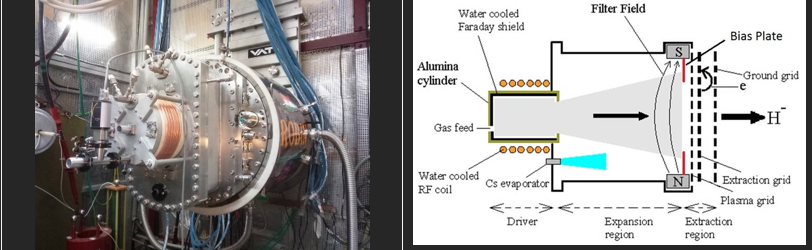
ROBIN stands for RF Operated Beam source in India for Negative ions. It is a negative hydrogen ion source test facility at the Institute for Plasma Research (IPR). It is the first stepping stone of IPR’s negative ion source R&D program, started during the same time India joined the ITER program as an equal partner. A collaboration is established with IPP, Garching, Germany, to setup ROBIN facility. The first plasma was created in the ROBIN source in 2011. The primary objectives of ROBIN are:

  • The production of inductively coupled RF (Radio Frequency) hydrogen plasma using a 100 kW, 1 MHz RF generator.
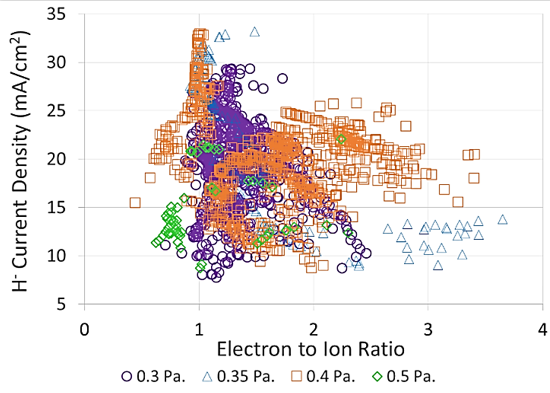
  • Negative hydrogen ion production inside the plasma through volume process and surface conversion (through injection of cesium vapor) process, and subsequently negative hydrogen ion beam extraction to achieve > 30 mA/cm2 negative hydrogen ion current density with co-extracted electron-to-ion ratio < 1.
  • Plasma and beam characterization to study plasma and ion beam dynamics, supported by modeling and simulation.

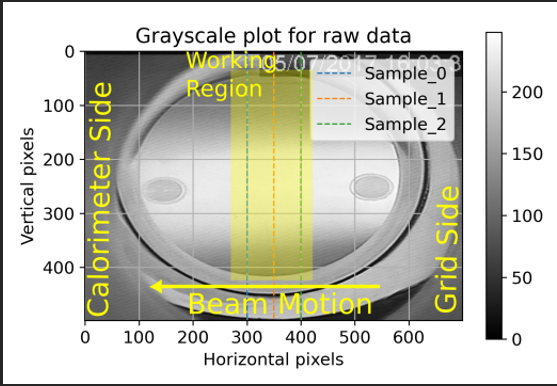
The negative hydrogen ions are extracted using a three-electrostatic multi-aperture (total 176 apertures) grid system. Once extracted, the beam travels along the beam transport line inside a long cylindrical vacuum chamber and is dumped onto a water-cooled, thermocouple-embedded calorimeter target plate for beam power and profile characterization. The negative ion beam extraction process consists of two steps. First, negative ions are extracted. Due to the same charge state, plasma electrons are also co-extracted, which are eventually filtered out by the extraction grid magnetic field and dumped onto the extraction grid structure. In the second step, those ions are accelerated to a desired beam energy. The extraction voltage of the power supply can reach up to 11 kV (floating), while the acceleration voltage can go up to -35 kV (grounded) in the ROBIN setup. Therefore, the total beam voltage can reach a maximum of 46 kV. The optimization of source performance focuses on the negative-ion current density, co-extracted electron-to-ion ratio, and beam transmission etc. The ROBIN facility has recently been upgraded to support neutral beam research.

ROBIN ion source is equipped with various diagnostic systems. For plasma characterization, electrical probes of different types, high-resolution as well as low-resolution spectrometers for optical emission spectroscopy, an Nd-YAG laser for cavity-ringdown spectroscopy, and laser photodetachment are used. Diagnostics like Doppler-shift spectroscopy, visible camera-based imaging, and a thermocouple-based calorimeter plate are used for beam characterization.
Overview
ROBIN Source
Experiments

1.Plasma production and characterization experiment

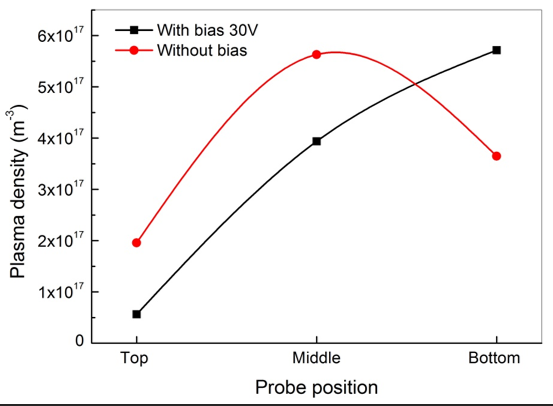
Inductively coupled RF plasma (up to 80 kW) is generated in the ROBIN facility. Plasma characterization experiments were performed using three movable Langmuir probes, positioned both axially and transversely in the extraction region. The plasma non-uniformity observed in the extraction region can be attributed to the cumulative plasma drift due to the gradients of plasma density, plasma potential and the magnetic field of the transverse magnetic filter. Nearly one order higher density and temperature were measured in the driver region compared to the extraction region. Optical emission spectroscopy is employed to monitor the plasma, cesium, and any impurities present in the source.

2.Negative ion beam extraction and optimization experiments

Experiments on negative ion beam extraction have been conducted in both pure volume and surface modes (with cesium vapour) at the ROBIN facility. The performance of the source has significantly improved in surface mode. A negative ion current density exceeding 32mA/cm² with an electron-to-ion ratio of approximately 1 during operation in surface mode when cesium consumption has been optimized and below 10 mg/hr. The beam has been characterized through various electrical, optical, and thermal measurements in ROBIN.

3.Ion beam neutralization experiments

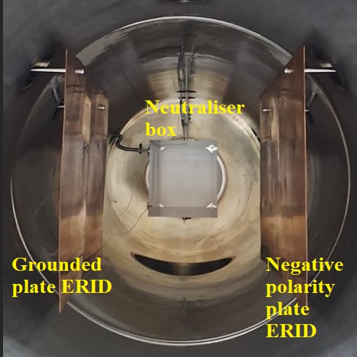
The ROBIN test facility has been upgraded for ion beam neutralization experiments. A gas- cell-based neutralizer and an electrostatic ion separator for filtering out un-neutralized ions are installed inside the ROBIN drift chamber in the ion beam neutralization experiment. Around 50-60% ion beam neutralization efficiency is observed in ROBIN with the available vacuum pumping facility. Estimation is done by beam current and beam power measurements. Beam-induced plasma formation is observed in the electrostatic ion separator region.

4.Beam Diagnostics

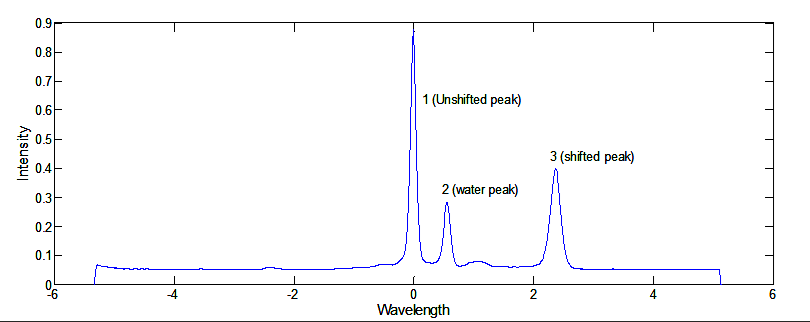
Beam Emission Spectroscopy: The ROBIN vacuum vessel is equipped with angled view ports relative to the beam axis for conducting Doppler-shifted beam emission spectroscopy. As the beam interacts with the background gas, light is emitted and collected through a collimated lens. This light is then directed to a high-resolution spectrometer, and the H-alpha emission line is chosen to analyze the beam properties, including the beam velocity from spectral-line shift (which gives beam energy), the width of the shifted line (which gives beam divergence), and extra shifted line(s) corresponding to the presence of impurities. It can even quantify the stripping loss of the H- ion beam. If one has multiple Doppler-shift lines of sight, beam uniformity can also be estimated.

Head Details

Dr. Mainak Bandyopadhyay

Dr. Mainak Bandyopadhyay

Designation
:
SO-H
Phone
:

Team Members

Vikas Prajapati

Vikas Prajapati

Designation
:
Scientific Assistant – B
Phone
:
Bhaveshkumar Khemchandbhai Prajapati

Bhaveshkumar Khemchandbhai Prajapati

Designation
:
Scientific Assistant – D1
Phone
:
Vuppugalla Mahesh

Vuppugalla Mahesh

Designation
:
Scientific Officer – E
Phone
:
Kaushalkumar Bhanushankar Pandya

Kaushalkumar Bhanushankar Pandya

Designation
:
Scientific Officer – E
Phone
:
Agrajit Gahlaut

Agrajit Gahlaut

Designation
:
Scientific Officer – G
Phone
:
Mainak Bandyopadhyay

Mainak Bandyopadhyay

Designation
:
Scientific Officer – H
Phone
:
Last Updated: 18-Jun-2026 04:06 PM