
Neutral Beam Injection (NBI) is an established and highly effective auxiliary heating technique in tokamak plasmas, widely employed for plasma heating, non-inductive current drive, and momentum input. In this method, ions of hydrogen isotopes are accelerated to high energies and subsequently neutralized through a charge-exchange process, enabling them to penetrate the confining magnetic field. Once inside the plasma, these energetic neutral atoms are ionized through collisions with plasma particles, producing fast ions that are magnetically confined. These fast ions transfer their energy to the background plasma via Coulomb collisions, resulting in an increase in both ion and electron temperatures as well as overall plasma pressure. The Positive Neutral Beam Injector (PNBI) of the SST-1 tokamak is designed to deliver a hydrogen neutral beam with a power of more than 1.0 MW for efficient plasma heating. The NBI physics section is engaged in the operation, characterization, and optimization of positive ion-based neutral beam systems for SST-1, along with development efforts to meet future heating & current drive requirements.
Positive NBI Physics
Overview
Positive NBI Physics
Experiments
Beam extraction
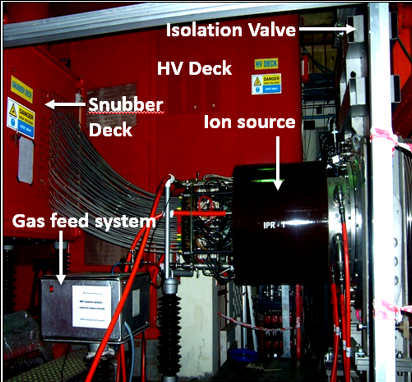
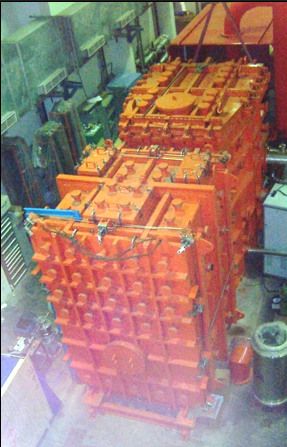
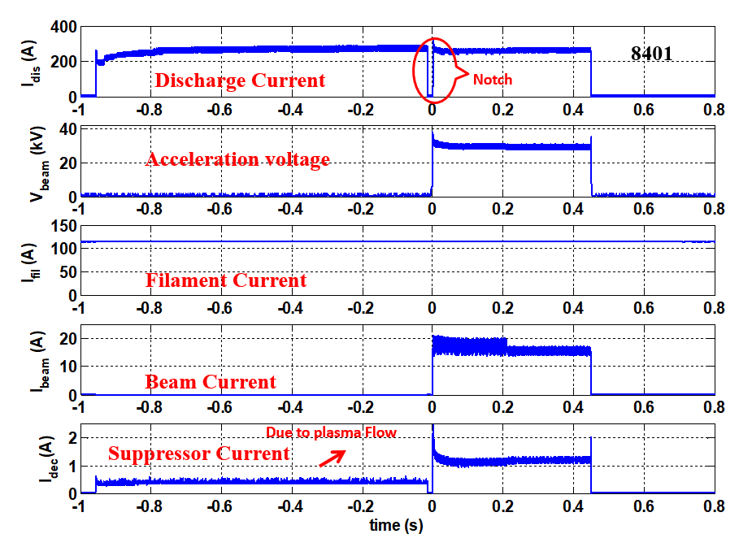
The Neutral Beam Injection (NBI) system is presently operated on a test stand for the generation and characterization of high-energy hydrogen neutral beams. The system consists of a large vacuum vessel integrated with an Ion source, vacuum vessel which houses neutralizer, electromagnet, magnet liner, calorimeter, ion dump, beam transmission duct, cryo-condensation pumps. The neutral beam system is operated with help vacuum system, gas feed system, cryogenic plant, regulated high voltage power supply (0–55 kV, 80 A), filament power supply, discharge power supplies, Control and data acquisition system. The neutral beam is characterized using calorimetry system and Doppler shift spectroscopy.
Positive NBI Physics
Neutralization
Positive NBI Physics
Beam transport
Positive NBI Physics
characterization
Head Details

Team Members

Mr. Bhargavkumar R. Choksi
Designation
:
Technical Officer D

Ms. Shrabani Karmakar
Designation
:
Technical Officer C