1.Plasma Immersion Ion Implantation
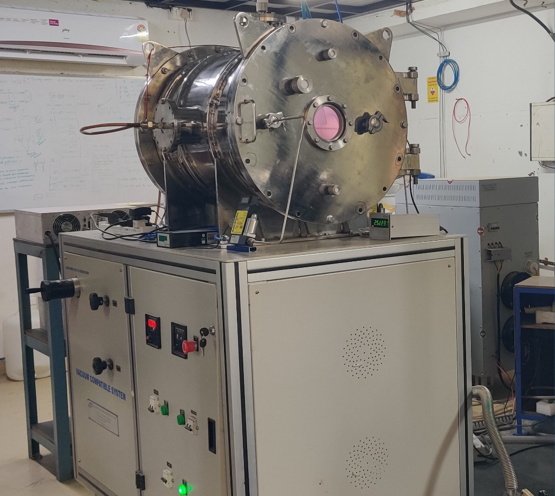
Plasma Immersion Ion Implantation (PIII) is an advanced surface engineering technique used for modifying the physical, chemical, and mechanical properties of materials by implanting ions into material surfaces (particularly metals). The process is widely applied in improving hardness, wear resistance, corrosion resistance, biocompatibility, thin film adhesion, and semiconductor device performance. A low-energy (20 keV max.) proto type PIII system is developed at IPR. It is equipped with a 1000 W RF plasma source and a high-voltage negative pulsed DC power supply (20 kV, 1 A). The system offers programmable pulse frequencies from 100–1000 Hz, pulse ON times of 50–150 µs, fast rise/fall times, and good fluence, enabling precise and reliable surface modification research. The facility can be used for implanting gaseous ions for engineering material surfaces. It can also be used for simulating important aspects of low energy (20 keV max.) plasma-material interactions in fusion plasma environment. System has been demonstrated for nitrogen implantation in to Al samples.
2.Development of Atmospheric Pressure Plasma Jets
and its applications.
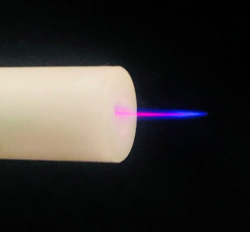
IPR has indigenously developed atmospheric pressure plasma Jets (APPJs) for bio-medical applications. Additionally, the development of multiple array of APPJ is being pursued. On the R&D level, APPJs are being studied for the treatment of cancer tissues and cell such as oral, gliomas, lung cancer line etc,. along with wound healing applications. In parallel, APPJs are also explored in dental care applications
3.Development of plasma based coatings using planar and cylindrical magnetron sputtering.
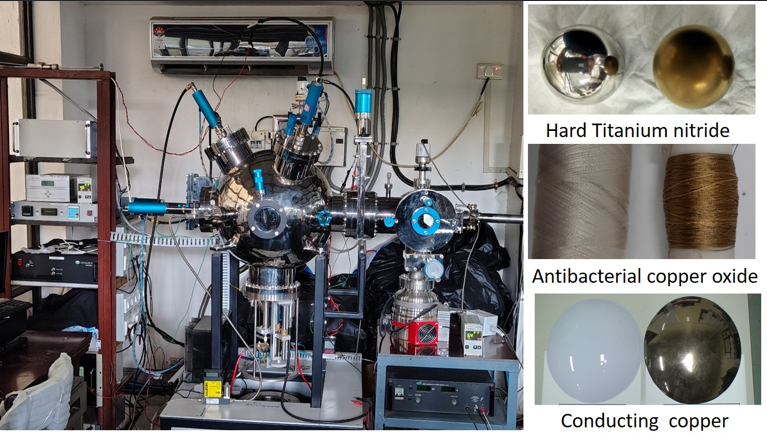
Sputtering based coatings are atomistic deposition processes which are operated at relatively low temperature. PSED division has developed magnetron sputtering systems which are used to perform coatings of different metals (Cu, Al, Zn, Ti, Cr, Ag, Mo, W etc.) as well as compounds (TiN, TiAlN, ZnO, CuO etc). The magnetron configurations like circular, rectangular, cylindrical are used for coating different type of substrates. These coatings are being designed for a range of applications, including antibacterial coatings, hard coatings, and corrosion-resistant coatings. Additionally, experiments are underway to develop a few microns thick tungsten-based coatings, which can endure high heat flux and erosion in the plasma-facing components of fusion reactors.
4.Multi-layer Thin Film Deposition using Magnetron Sputtering Technique
The Lab specializes in advanced
multi-layer thin film deposition using a multi-chamber multi-magnetron (MCMM)
sputtering system to engineer high-precision single and multi-elemental layers,
which enables the fabrication of complex multilayer thin film structures
essential for next-generation technologies. The research spans diverse,
critical applications, including photovoltaic (PV) devices, high-temperature
superconducting (HTS) tapes, and multilayer mirrors (MLM) for X-ray
spectrophotometer etc. Having successfully developed key layers for solar PV
devices, the current research focuses on design and deposition of
high-reflectivity MLM coatings for soft X-rays. Through state-of-the-art deposition techniques, the
lab continues to bridge the gap between material science innovation and
practical engineering solutions.
5.Development of Plasma Electrolyzer System for
Hydrogen Production .
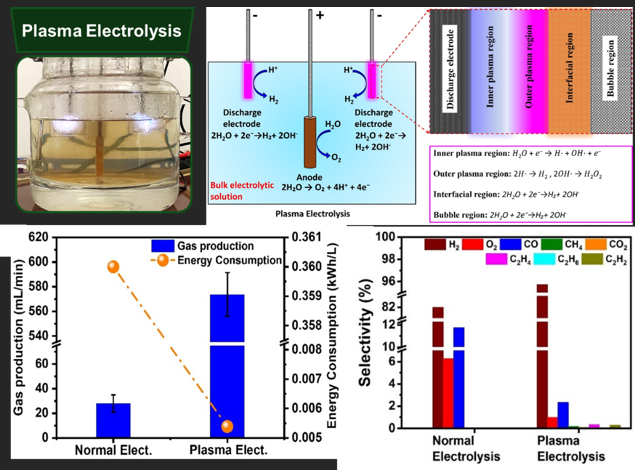
This research focuses on plasma electrolysis process and the development of a plasma electrolyzer system for efficient hydrogen production. The work explores the fundamental physics of plasma–liquid interactions and plasma-assisted electrochemical processes to enhance hydrogen generation under energy-efficient operating conditions. Emphasis is placed on understanding charge transfer mechanisms, reactive species formation, and interfacial plasma dynamics in electrolyte systems. The research also involves the design and engineering of electrocatalysts and electrode architectures to improve catalytic activity, stability, and hydrogen evolution efficiency. This integrated approach contributes to the development of clean-energy technologies for next-generation green hydrogen production systems.
6.Plasma Carburizing for enhanced surface hardness.
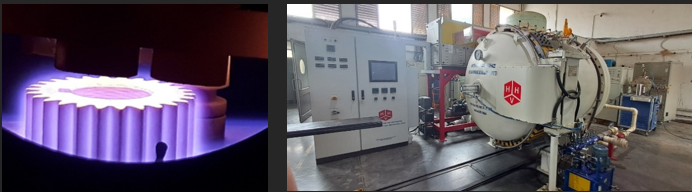
Plasma Carburizing experiments are in progress for the process optimization for different grades of low carbon steel like mild steel AISI 1020, low alloy case hardening steel AISI 8620, medium carbon engineering steel EN8, high strength alloy steel EN24 and case hardening alloy steel 20MnCr5. The process optimization includes the study of influence of process parameters like operating temperature and boosting temperature, time duration, gas compositions on tribological properties of listed steels. Further experiments will be carried out on industrial components like gears for distortion, hardness and diffusion layer thickness.
7.Plasma
Material Interaction Studies for fusion to industrial applications.
Plasma–material interaction studies are being conducted for surface modification of a wide range of materials from fusion-relevant, space and for industrial applications. For this purpose, two low-energy Kaufman-type ion beam facilities are established. These facilities are capable of generating ion beams with energies ranging from 50 eV to 1500 eV with Ar and Xe ions. These ion beams are used to create diverse surface textures such as ripple patterns, dots, and facets on substrates including silicon, glass, GaSb, polymers, graphite, ceramic and others. The modified substrates have potential applications in molecular sensing, surface wettability control, reflectivity tuning, erosion rate studies, sensing and magnetic property enhancement. In addition to ion beam facilities, plasma material interaction (PMI) lab is equipped with an RF plasma and a fireball-based DC plasma etching system for tailoring the surface wettability of various materials along with magnetron sputtering based PVD coaters. These systems can also be utilized for depositing metallic and non-metallic coatings on substrates of interest.