1.SST-1 Thomson Scattering System
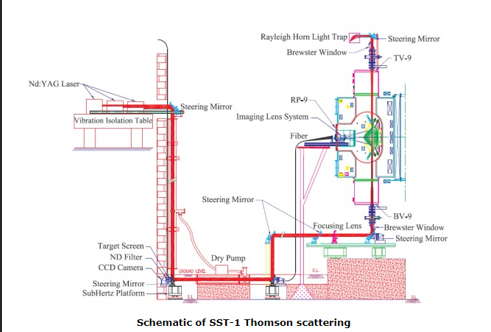
A multi-pulse Nd:YAG laser based Thomson scattering (TS) system is used for measuring electron temperature (Te) and density (ne) profiles of SST-1 tokamak. The SST-1 TS system is designed with six Nd:YAG lasers, a multipoint imaging system for collecting scattered photons, a five-channel interference filter polychromator for spectral dispersion, and avalanche photodiodes (APDs) for detection. A charge integrator based data acquisition system operating on PXI bus is developed for data acquisition. The system is designed for measurements at 20 spatial locations covering the core, edge, and divertor regions, with 10 spatial channels currently operational. The system measures electron temperatures from 100 eV to 1 keV and densities above 2 × 10¹² cm⁻³.
2.Development of Aditya-U Thomson Scattering System
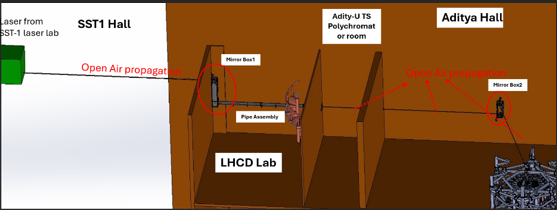
Another Thomson Scattering diagnostic system is under commissioning for the Aditya-U tokamak for measurements of electron temperature and density profiles. The system includes 65 m long laser transport line to utilize the same laser system of SST-1 for ADITYA-U also, collection optics, filter polychromators, and imaging systems for high-resolution plasma measurements. Current activities involve commissioning of the laser transport line system, photon collection optimization, calibration activities, and integration of optical diagnostics.
3.Helium Beam diagnostics and beam
plasam interaction studies
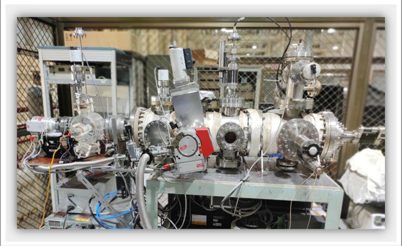
The experiment focuses on the generation and characterization of a helium neutral beam system for edge plasma diagnostic applications in fusion devices. The setup includes a neutral beam source, beam transport system, and diagnostic tools for measuring beam properties such as density distribution, beam profile, divergence, and temporal evolution. Characterization studies are carried out using Shielded Ionization Discharge (SID) probe diagnostics, optical measurements, and spectroscopic techniques. The activity supports the development of edge diagnostics, beam–plasma interaction studies, and validation of diagnostic methodologies relevant to tokamak plasma experiments and fusion applications.
The CCRF plasma studies focus on the characterization of capacitive coupled RF plasma discharges using electrical and optical diagnostics. The work includes investigations of plasma parameters under varying RF power, pressure, gas composition, and magnetic field conditions using Langmuir probe diagnostics and optical emission spectroscopy. The studies support understanding of electron heating mechanisms, ionization processes, metastable process, and collisional–radiative modeling for low-temperature plasma applications
4.Libs and Micro Raman System for
studying Plasma wall interaction
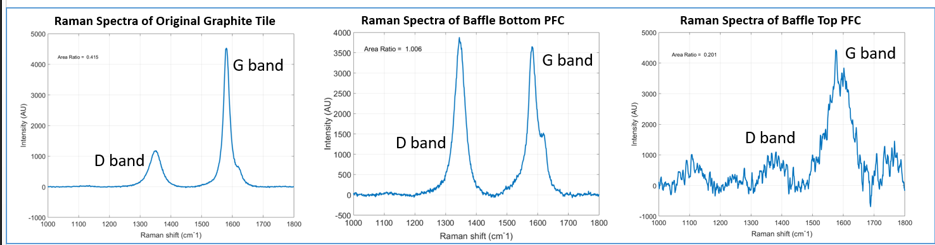
Substantial interest in post-mortem analysis of plasma-facing components (PFCs) using LIBS and micro-Raman spectroscopy has grown in recent times. A configurable Raman system is procured and employed as a non-destructive diagnostic technique on graphite PFC tiles and viewport coatings from SST-1 tokamak. It is used to assess irradiation-induced structural changes in tiles removed from different poloidal and toroidal regions. A Laser Induced Breakdown Spectroscopy (LIBS) system is additionally employed for detailed compositional analysis of Viewport coating. Significant calibrations and bench testing have been performed. A fiber-coupled optics based in-situ Raman diagnostic is currently under development.
5.Laser Produced Plasma
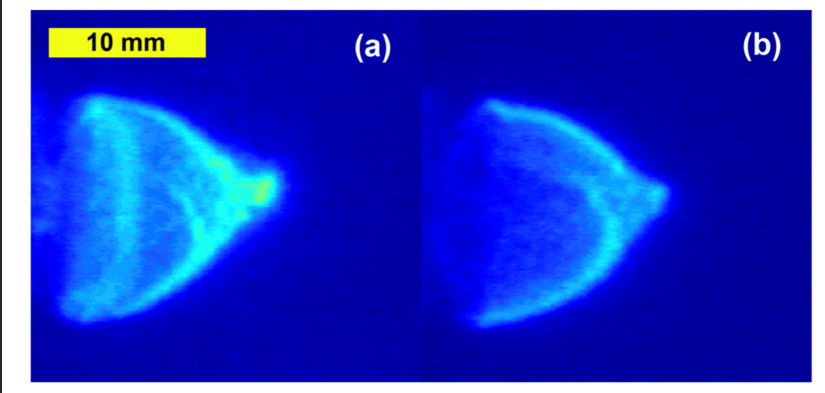
Laser-produced plasmas generated from a variety of target materials are investigated. Using nanosecond pulsed lasers, experiments are conducted under controlled ambient gas conditions at varying background pressures, laser fluence, time and spatial configurations. Optical emission spectroscopy, time-of flight measurements, and polarization-resolved spectroscopy are employed to explore plasma dynamics and radiative processes. Both line and continuum emissions are studied under different conditions. Accurate measurements of plasma parameters such as electron density and temperature are carried out. Delayed plasma emissions, multi-charged ion acceleration mechanisms, emission anisotropy and inverse Bremsstrahlung absorption by plasma are also actively investigated.
6.Study of Laser-Induced Plasma and Ablation
Dynamics in Thin Films for Fusion Optics Cleaning Applications
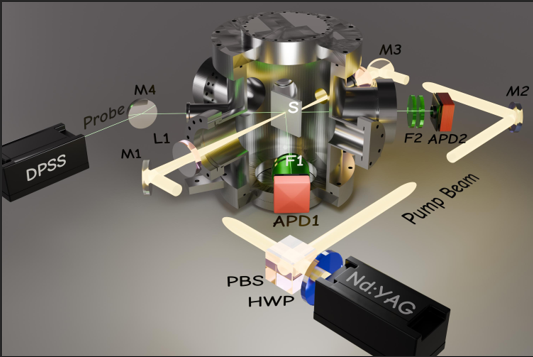
This work focuses on developing laser-based cleaning methods for optical components such as mirrors and viewports used in fusion reactor plasma diagnostics. An innovative experimental setup employing front and rear laser ablation of thin film combined with pump–probe diagnostics was developed to investigate laser cleaning dynamics and optimise cleaning parameters including fluence, pulse number, ambient conditions etc. Aluminium, Silver, Nickel thin films deposited on quartz substrates were used as model contamination layers representative of fusion reactor deposits. The study examines ablation efficiency, redeposition effects under different pressure conditions, and pulse requirements for complete coating removal, providing insights for developing reliable cleaning protocols for fusion reactor optical diagnostics. The experimental setup also provides deeper insight into the fundamental mechanisms of laser ablation and will be further integrated with interferometric diagnostics to study laser-produced plasma, laser absorption mechanisms, and shock-wave propagation through thin films and substrates during laser cleaning.