
Open House Help Desk Open House Public Grievances IPR Act and Rule
Opportunities Annual Reports Tender Dashboard

High Power Thruster

High Power Thruster
Overview


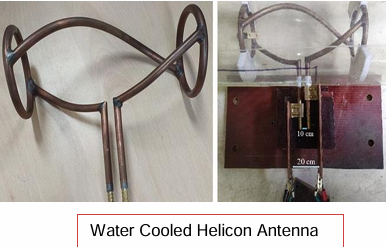
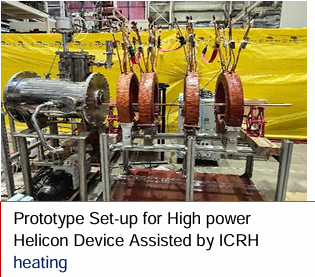
High Power Thruster Section is responsible for the development of High Power Helicon plasma device assisted by ICRH heating for fusion related studies. The section is engaged in the following activities:

  1. Physics design of 20 kW Helicon plasma system that involves physics design of the plasma source, development of water cooled helical antenna for 20 kW RF power @ 13.56 MHz, generation of > 1019 m-3 plasma density @ >10 eV electron temperature.
  2. Development of 50 kW ICRH system that includes design of water cooled antenna for 50 kW RF power, transmission line, launch and coupling of ICRH wave with plasma to increase the ion temperature to ~10 eV.
  3. Design of magnetic nozzle to enhance the ion flow to > 10 km/sec to achieve plasma detachment that will help in simulating Tokamak divertor plasma, complex flow patterns found in the scrap-off layer of Tokamak etc.

The main objective is:

  1. To study Helicon wave physics useful for high density plasma production that will lead to helicon wave current drive knowledge for Tokamak plasma.
  2. ICRH heating experiment relevant to Tokamak ICRH coupling and heating study.
  3. High Mach no flow generation through nozzle acceleration and detachment physics.
High Power Thruster
Experiments

High power Helicon device with ICRH heating for Fusion Related Studies

The set-up consists of a helicon plasma source (1.6 m long quartz tube with 50 mm ID) in order to generate plasma density > 1019 m-3 with RHCP helical antenna. Plasma is further heated at ICRH frequency by applying power to LHCP antenna. ICRH heating increases the perpendicular component of the ion flow velocity. Plasma particles then exit through the magnetic nozzle (a specific magnetic field configuration achieved by combination of electromagnets and permanent magnets) where the perpendicular velocity is converted to axial flow velocity in a decreasing magnetic field for plasma detachment to happen. Plasma exits into a diffusion chamber of 42 cm ID and ~80 cm length fitted with 8 radial and 1 axial port, is pumped by turbo-molecular pump Pfeiffer HIGHPACE- 2300 through rotary pump Leybold TRIVAC-D60T, to achieve base vacuum ~10-7 mbar through electro-pneumatic compatible gate valve. A transducer THYRACONT VSH-89DL is installed to monitor vacuum. 4 Electromagnets capable of producing 6kG field are installed presently.

Head Details

Dr. Mainak Bandopadhyay

Dr. Mainak Bandopadhyay

Designation
:
Scientific Officer -H
Phone
:

Team Members

Ms.Renu Bahl

Ms.Renu Bahl

Phone
:
Dr. V. Sivakumaran

Dr. V. Sivakumaran

Mr. Mritunjay Kumar

Mr. Mritunjay Kumar

Mr. Sandip Das

Mr. Sandip Das

Last Updated: 18-Jun-2026 12:16 PM