
A tokamak, one of
the most promising devices for controlled nuclear fusion, typically operates in
pulses because it relies on an induced plasma current, analogous to a
transformer. Achieving steady-state operation requires non-inductive current
drive techniques. Lower Hybrid Current Drive (LHCD) is an effective approach in
which radio-frequency (RF) waves near the lower hybrid frequency are launched
into the plasma, transferring energy to fast electrons and driving plasma
current efficiently.
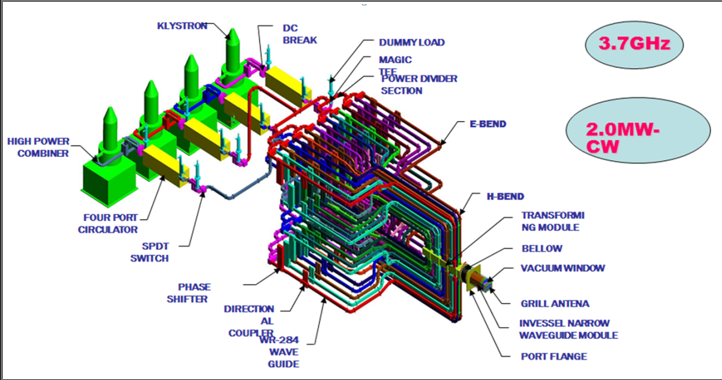
For SST-1, a 3.7 GHz
LHCD system comprising four 500 kW klystrons (total 2 MW) with a GRILL antenna
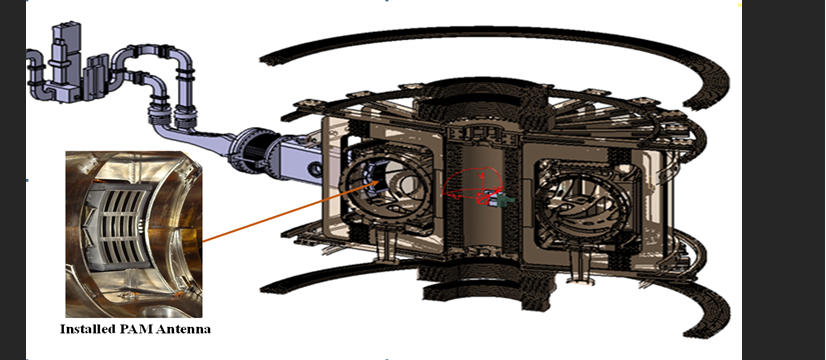
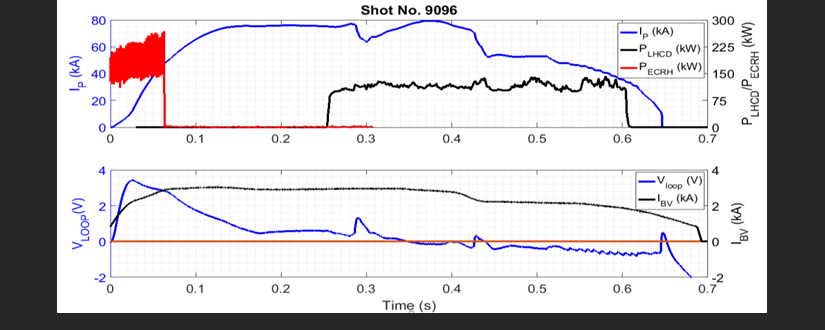
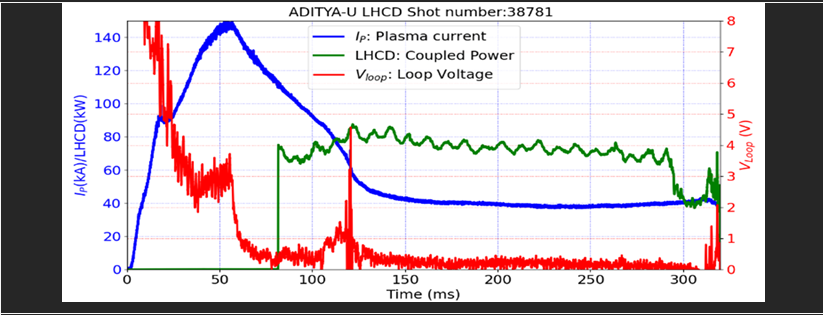
has been developed, while a PAM antenna based LHCD system (250 kW, 1 s) has
been implemented for ADITYA-U. The system integrates low-power RF drive, high-power
klystron amplifiers, and transmission line components, all characterized and
assembled. The klystron setup includes auxiliary power supplies for ion-pump,
filament, magnet, anode modulation, and high-voltage operation, tested and
synchronized with the system. PXI and VME based data acquisition and control
modules manage operation, while water cooling, gas pressurization, and
diagnostic -including RF power, Langmuir probe, and hard X-ray measurement
-ensure safe high-power operation and enable comprehensive data analysis.
The RF Pill Box type vacuum
window is designed to operate at 3.7 GHz for 125 kW, 1 second. The window is
tested for its functional characteristics like Ultrahigh Vacuum, Pneumatic test
and low power rf test before the high power rf testing. The test setup for low
power rf is shown in figure-3. The cold test of a window shows a return loss of
~30 dB and an insertion loss of ~0.01 dB. The window was tested up to rf power
of 150 kW (20% higher than the designed value) for 1 second. The high power rf
test result is shown in figure-4.