Open House Help Desk Open House Public Grievances IPR Act and Rule
Opportunities Annual Reports Tender Dashboard

High Power ECRH

High Power ECRH
Overview

ECRH (Electron Cyclotron Resonance Heating) is a main heating system for the fusion devices specially for superconducting tokamaks. In the tokamaks, ECRH is used for wide range of applications like plasma breakdown, start-up, wall-conditioning, plasma heating and NTM control etc. A standard ECRH system consists of high power microwave source (Gyrotron), corrugated waveguide based transmission line and quasi-optical launcher. The development of advance Gyrotrons (Megawatt class Gyrotron at frequency varying from 28GHz to 170GHz and beyond) has made ECRH even more attractive for future fusion machines.

At the Institute for Plasma Research (IPR), two advance ECRH systems (42GHz-500kW and 82.6GHz-400kW) have been installed and integrated with the tokamaks SST-1 and Aditya-U. The 42 GHz ECRH system is capable of delivering power up to 500 kW with pulse durations of up to 0.5 seconds. This system is integrated with both the tokamaks SST-1 and Aditya-U. The 42GHz ECRH systems has emerged as a mandatory heating system for 1.5T operation and has shown consistent performance since 2013. In SST-1, it is used for plasma breakdown, heating and current drive. In Aditya-U tokamak, the 42GHz system is connected through approximately 75-meter-long transmission line and many interesting experiments have been carried out at fundamental and second harmonic.

The 82.6 GHz ECRH system is integrated with SST-1 and this system delivers up to 400 kW of RF power for pulse durations of 0.5 seconds. In SST-1, this system is used for second harmonic heating at toroidal magnetic field of 1.5T and fundamental harmonic at 3T.

Both Gyrotrons sources employ liquid helium-cooled superconducting cryomagnets. The systems are powered and controlled through indigenously developed high-voltage power supply units, reflecting significant in-house technological capability in high-power microwave and fusion engineering systems. The 55kV-110A MHVPS (Main High Voltage Power Supply) currently is being used for the operation of these Gyrotrons.

Section's Present Status & Achievement

  • Successfully commissioned and demonstrated reliable operation of the 42 GHz and 82.6 GHz ECRH systems on both matched dummy loads.
  • The 42GHz-500kW ECRH system is a unique system which operates on two tokamaks (SST-1 and Aditya-U) and many interesting ECRH experiments have been carried on both the tokamaks.
  • The 82.5GHz-400kW ECRH system is integrated on SST-1 tokamak.
  • ECRH-assisted plasma breakdown and electron cyclotron heating experiments are carried out on both the tokamaks (SST-1 and Aditya-U) at fundamental and second harmonic.
  • A high-power pulsed dummy load has been designed, developed and tested successfully at high power.
  • An advance launcher with high-precision steerable mirror is developed indigenously and this system is capable of rapid RF beam steering in both poloidal and toroidal directions on millisecond time scales.
  • Indigenously developed power supply system (cathode, body and filament high-voltage power supply) for Gyrotrons are operating reliably on both the ECRH systems.
High Power ECRH
Experiments

1. ECRH assisted breakdown and heating experiments of SST-1 Tokamak

ECRH is a well-established auxiliary heating technique in which high-frequency microwave power - generated by a gyrotron is injected into a magnetized plasma and it is absorbed when the microwave frequency matches with the electron cyclotron frequency or its harmonics. This resonance condition causes electrons to gain perpendicular energy in a collisionless manner and efficiently heat the plasma.

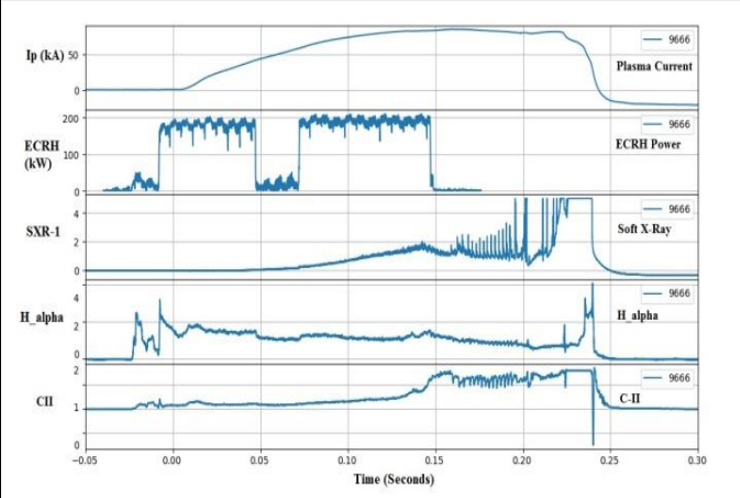
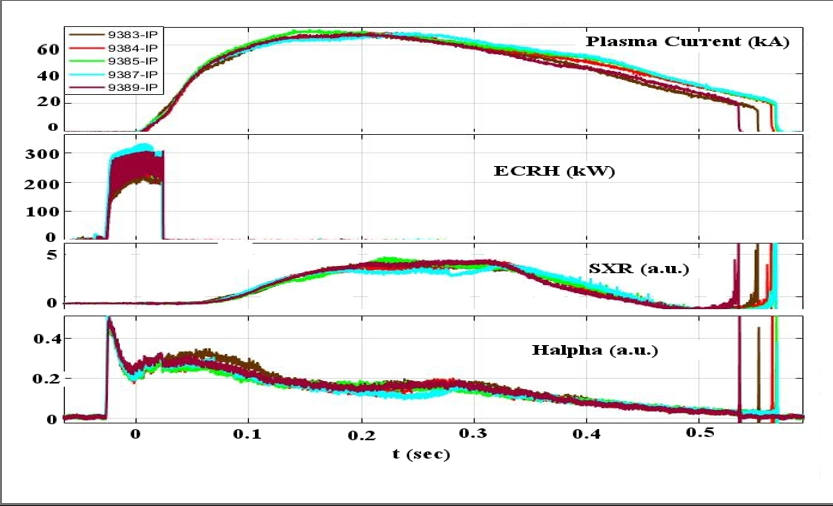
The  42 GHz ECRH system has given menay interesting results on both the tokamaks SST-1 and Aditya-U. In SST-1, the need of ECRH is critical as the loop voltage of SST-1 is only ~3.5 V which is not enough to breakdown and plasma start-up. Hence ECRH-assisted start-up is mandatory for reliable plasma discharges at both fundamental harmonic (at 1.5 T) and second harmonic operation (at 0.75 T). The microwave power propagates through corrugated waveguides in HE11 mode and is steered into the plasma by an electromechanical launcher system with steerable mirrors capable of movement across both poloidal and toroidal directions. Thus in SST-1, all the plasma shots are with ECRH assisted start-up, standard plasma discharges results are shown in following figure.

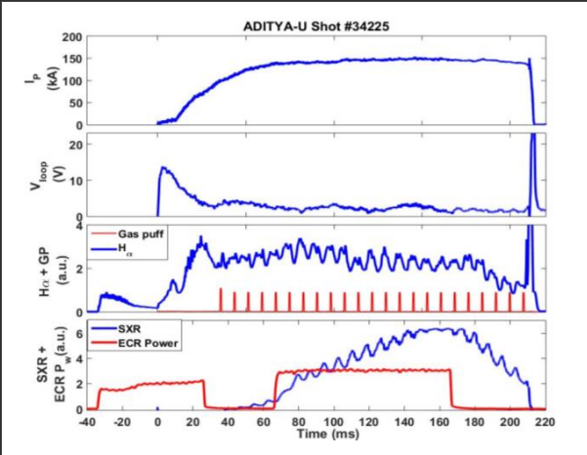
The Aditya-U tokamak which is an upgrade of the original Aditya tokamak with the replacement of rectangular vacuum vessel to circular one to accommodate the divertor coils for advance plasma experiments.  In Aditya-U, the normal loop voltage is around 22 V, but with ECRH assistance, successful plasma start-up was achieved at loop voltages as low as 6V and this saving in loop voltage helps to extend the plasma duration. In the Aditya-U, various ECH experiments at fundamental O-mode and second harmonic X-mode have been carried over a wide range of magnetic field 0.75T to 1.4T. In Aditya-U for breakdown, ECRH power was launched approximately 25 ms before the start of loop voltage, achieving a 40% reduction in peak loop voltage, with plasma currents of ~115 kA and discharge durations of ~250 ms demonstrated at ~12 V loop voltage. On Aditya-U, plasma heating has also been observed through an increase in soft X-ray (SXR) signal with ECRH power, with the bremsstrahlung-based SXR radiation indicating a rise in electron temperature in the fully ionized plasma. Notably, ECR heating has been demonstrated in deuterium plasma also, where a soft X-ray signal increase with ECRH power indicates effective EC wave coupling with the deuterium plasma.

Two pulse operation of ECRH system on SST-1 and Aditya- U tokamaks

The ECRH two-pulse experiments on tokamaks SST-1 and Aditya-U were enabled by upgrading the 42-GHz gyrotron system with a new advance anode modulator power supply with fast rise and fall time of 1 ms. The duration and ECRH power can be varied in both the pulses as per the requirement. The first pulse, kept below 150 kW, is used for plasma breakdown at the fundamental harmonic, while the second pulse with higher power ~200 kW is used for plasma heating. This separation is deliberate limiting power during breakdown minimizes the generation of high-energy electrons that can introduce impurities and degrade plasma quality.

In SST-1, where the loop voltage is below 5 V, ECRH-assisted start-up is mandatory for reliable plasma discharges; the first pulse triggers breakdown confirmed by immediate appearance of the Hα signal, and the second pulse of ~200 kW is launched after a 30 ms gap, spanning the current ramp-up to flat-top phase. While some increase in the electron cyclotron emission (ECE) signal was observed in SST-1 during the second pulse, conclusive evidence of heating remained elusive as the increase could partly be attributed to ohmic heating.

In Aditya-U, where the loop voltage (~20 V) is sufficient for breakdown, the two-pulse scheme offers the advantage of reduced volt-second consumption alongside simultaneous heating. The first pulse of 100 kW for 70 ms initiates breakdown, followed by a 150 kW second pulse for 50 ms; a clear increase in both SXR and ECE signals during the second pulse confirmed ECR heating in Aditya-U, making it the more conclusive demonstration of heating between the two tokamaks. Systematic follow-up experiments varying magnetic field, plasma density and synergy with ion cyclotron resonance heating ICRH and lower hybrid current drive (LHCD) are planned to further characterize the heating effects. 

Team Members

Dr. Braj Kishore Shukla

Dr. Braj Kishore Shukla

Designation
:
Scientific Officer-H
Phone
:
Rajan Babu

Rajan Babu

Designation
:
Scientific Officer- F
Phone
:
Harshida Patel

Harshida Patel

Designation
:
Scientific Officer- E
Phone
:
Hardik Mistry

Hardik Mistry

Designation
:
Scientific Officer- E
Phone
:
Dharmesh Purohit

Dharmesh Purohit

Designation
:
Scientific Officer-E
Phone
:
Kanubhai Parmar

Kanubhai Parmar

Designation
:
Scientific Officer-D
Phone
:
Ravindra Solanki

Ravindra Solanki

Designation
:
Scientific Assistant - B
Phone
:
Last Updated: 19-Jun-2026 11:48 AM