Dusty (complex) plasmas consist of micron-sized solid particles immersed in a plasma, where the particles acquire large negative charges and exhibit strong inter-particle interactions, often leading to liquid- and solid-like behaviour. These systems provide a unique platform to study fundamental processes such as collective dynamics, self-organization, and phase transitions at the kinetic level.
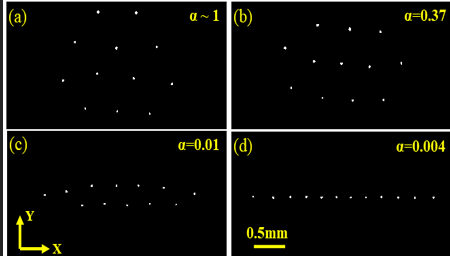
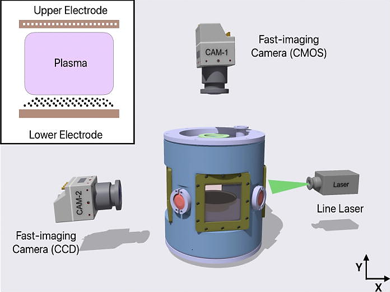
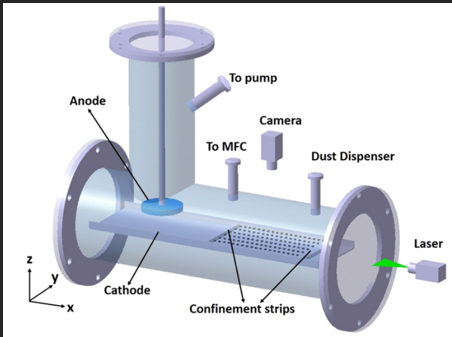
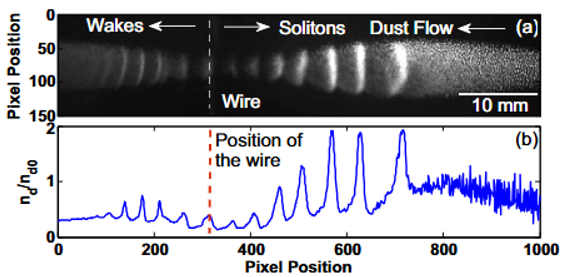
Dusty plasma experiments at the Institute for Plasma Research (IPR) have significantly advanced the understanding of both strongly coupled and flowing plasma systems. Using devices such as DPEx, DPEx-II, and CCDPEx, studies have explored dust acoustic waves, precursor and pinned solitons, shock waves, and Kelvin–Helmholtz instabilities in flowing plasmas. In the strongly coupled regime, experiments have demonstrated dust crystal formation, structural transitions, and phase coexistence, including controlled melting using laser heating. In the CCDPEx device, detailed investigations of structural transitions and laser-induced melting patterns have provided further insight into nonequilibrium phase behaviour. Notable findings include the observation of square lattice structures and studies of phonon modes, particle dynamics, and transport properties. These works collectively advance the understanding of nonlinear dynamics, self-organization, and collective behaviour in complex plasma systems.