
Artificial Intelligence (AI) & Digital Twin is an evolving area which comprises application of Tokamak Physics models & simulation, simulated & experiment data with AI/ML, Agentic AI. AI today is accelerating nuclear fusion research by improving & optimizing tokamak reactor designs, and enabling faster data analysis. AI-driven digital twins, image processing, and machine learning models analyze real-time sensor and simulation data to predict instabilities, automate reactor operations, and reduce simulation times from minutes to milliseconds. Use of these technologies to enhance reactor design and performance to bring commercial fusion energy closer to reality. AI and agentic AI in tokamak reactors face challenges such as handling complex plasma behavior, ensuring accuracy along with challenges of limited training data, high computational demands, integration with reactor systems, and difficulties in explaining AI decisions. These challenges must be addressed for AI in fusion reactors become practical. Today AI & digital twin division at IPR is involved in various projects internal & external projects involving AI , image processing using for detection, prediction and LLM models along with using simulation codes to generate data and create and train AI surrogate models .
Al and Digital Twin
Overview
Al and Digital Twin
Experiments
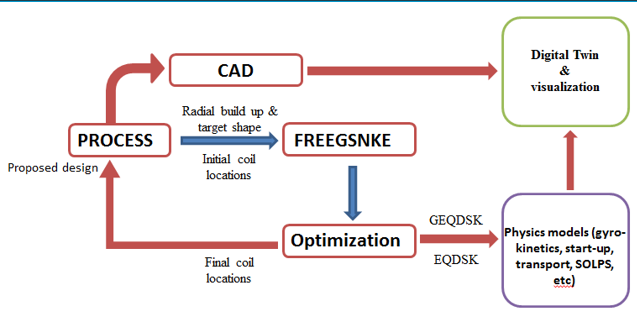
1.Equilibrium Studies and Coil Optimization Framework for Conceptual Tokamak Design
This activity focuses on the integration of
free-boundary equilibrium solvers with advanced optimization algorithms to
support conceptual tokamak design studies. The framework is developed to
generate and analyze a large database comprising lakhs of free-space
equilibrium solutions. Systematic data analysis is then performed to identify
and optimize configurations that satisfy prescribed plasma performance targets
and design constraints
2.Digital Twin for Tokamak
Digital twin framework for tokamak system needs the various output physical quantities for visualization and analysis. The work involves modeling and simulation of quantities such as plasma equilibrium, plasma pressure, electron and ion temperature and their respective profiles.
a. Simulation of Tokamak
Plasma Discharges
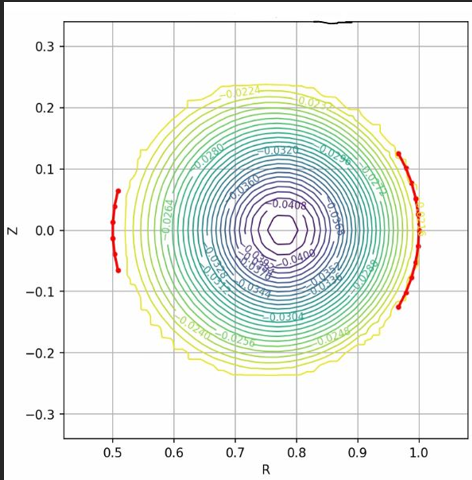
Time evolution of plasma MHD equilibrium along with the plasma pressure profile and electron and ion temperature profiles is simulated in 1.5 D simulation code that solves MHD equation in 2 D for plasma equilibrium calculation and flux averaged 1 D calculation of energy transport. These simulations are used for generation of data required for visualization/analysis in digital twin framework.
b. AI for Tokamak Digital Twins
AI surrogate model development for predicting Psi values in feed-forward calculations, of the ADITYA machine. The approach achieves an approximate 480× speedup for 1000 equilibria cases.
c. Physics Informed Neural Network (PINNs) for equilibrium reconstruction for ADITYA-U tokamak : Traditional methods are slow and need high computation and data-driven AI models require large amount of data to be trained, PINNs solves this problem and uses the physics to train the model. It includes the physics equations directly into the loss function and thus making it a suitable fast and data efficient surrogate model for ADITYA-U Digital Twin development
3.Digital Twin visualization Framework
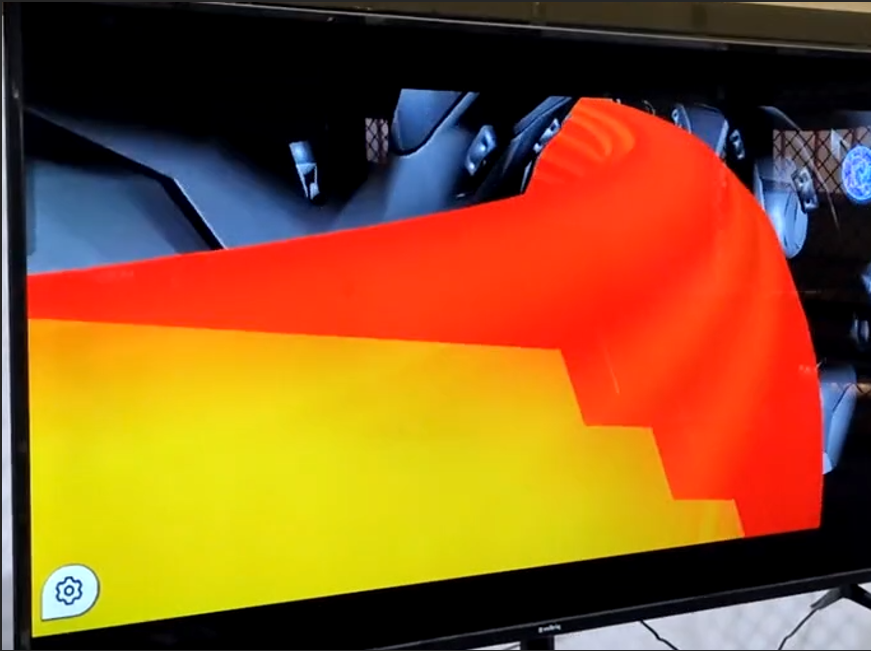
a. Browser-based visualization framework for the Aditya-U Tokamak, enabling interactive analysis of plasma equilibria. Implemented a real-time pipeline to generate & overlay on-the-fly equilibrium solutions onto 2D CAD models for intuitive interpretation. Performance benchmarking across multiple hard ware platforms are performed which shows that high-throughput CPUs can render large volumetric plasma datasets in digital twin environment.
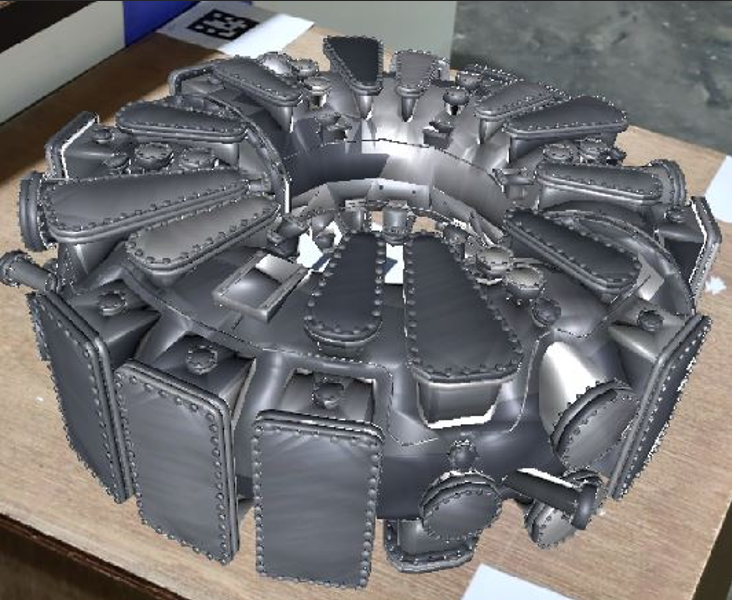
b. Tool for visualizing physical parameters within tokamak geometry in 3D for ADITYA tokamak, the tool is supposed to work using both PC as well as mobile devices with Augmented and Virtual reality controls using open source tools for improvised understanding of changing parameters within space and time. Parameters currently used are Psi values calculated using simulation codes for specific shots and magnetic field lines that bound the plasma in Tokamak.
4.Image processing and its application in Tokamak
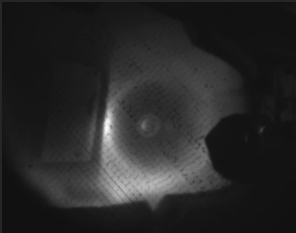
1. Visible image acquisition is one of the activities during Plasma experiments to diagnose Tokamak Plasma. Due to the presence of strong magnetic fields in and around Tokamak, the camera cannot be directly kept inside the Tokamak. For imaging purpose where camera can’t be used directly, optical fiber bundle is used with camera to capture image. The image captured using optical fibre bundle has some noise, which is referred as Honeycomb structure. Software package developed for removal of honeycomb structure. The executable software package is capable to read from USB/IP camera or from stored video file.
2. Image processing based system for Gap control in high power plasma torch system
The plasma torch system generates high temperature plasma arc using graphite electrodes, it comprises of two anode electrodes and one cathode electrode. These electrodes are consumables, hence to maintain the required gap these electrodes are mechanically moved linearly using the stepper motors driven through feedback system. An image processing based system is developed and tested to automate it. Image processing technique is implemented to monitor and maintain the prerequisite gap between these electrodes.
5.Artificial Intelligence, Machine Learning & Large language model for Tokamak & other
1.
Developed online video classification model for
Aditya-U to predict plasma shot length within 120 frames (~20 ms) with accuracy
>95%, and developed a machine-centric surrogate AI model to estimate plasma
parameters using inputs from magnetic probes.
2. Development of DeepCXR Software solution, deployment
and implementation.
a. Development: DeepCXR - Artificial Intelligence (AI) for Automatic Screening/detection of Pulmonary TB and other lung diseases using Chest X-rays
b.
Deployment: The offline version of
the DeepCXR software has been successfully deployed in the field, along with an
integrated dcm2png utility to enhance usability and workflows. In addition, for
online version multiple monitoring modules—including site consistency checks,
log monitoring, instance validation, and log integrity checks—have been
developed and are fully operational, ensuring efficient system performance. More
than 2000 sites are integrated with DeepCXR. The syncing and AI-related backend
code are continuously developed and deployed using a CI/CD pipeline.

Obtained ISO 13485 and ISO 27001 certifications for Lab to ensure compliance with quality and information security standards of products developed there..

Head Details

Team Members